
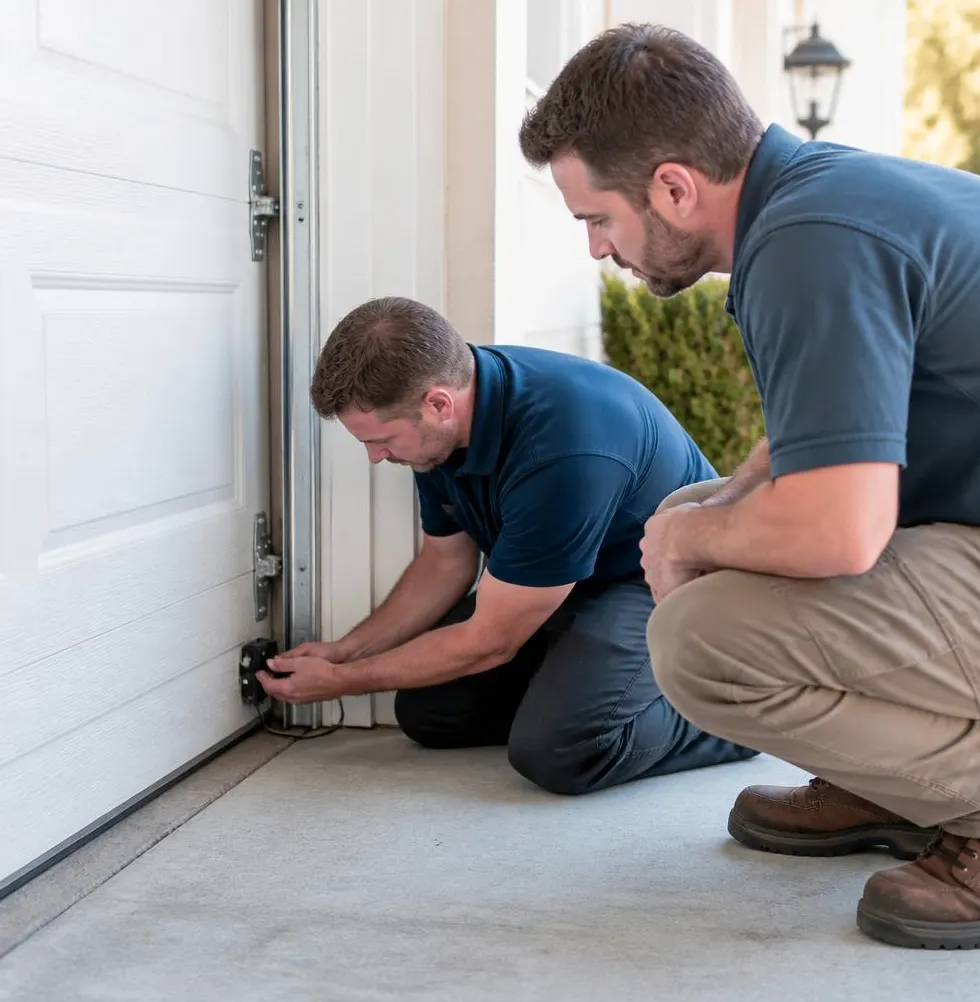
What a Technician Sees on a Call Like This
The call usually starts with something small — a squeak, a door that's slow to close, a remote that only works half the time. But once a technician is standing in the driveway looking at the actual hardware, the real story comes out: a torsion spring with no containment cable, lift cables fraying where they wrap the drum, an opener from the Clinton administration with no photo-eye sensors at all, or sensors that are there but unplugged because "they kept beeping." This is extremely common in homes around here with original equipment — older housing stock in this area often still has the garage door and opener the house was built with, and nobody's touched it except to replace a remote battery.
That's usually when the argument starts. One spouse says, "It's worked fine for thirty years, leave it alone." The other says, "We need to replace the whole thing before someone gets hurt." The honest answer is in between — some of this hardware is a genuine safety issue, and some of it is just old and ugly. Here's how to tell the difference.
Retrofit This — No Debate
Auto-reverse safety sensors
Garage door openers built in the early-to-mid 1990s and later were designed to include photoelectric sensors near the floor that stop and reverse the door if something breaks the beam. If your opener predates that, or the sensors have been removed, bypassed, or just left dangling and disconnected, this is the single most important item on the list. A door that doesn't sense an obstruction and reverse is a real hazard for kids, pets, and cars. This isn't a judgment call — if the sensors aren't there or aren't working, get an opener that has functioning auto-reverse.
An unprotected torsion spring
If the spring above your door has no containment cable running through its center, a spring failure can send metal flying with real force. This is cheap insurance for an old system and should be added regardless of whether the spring itself looks fine.
Frayed, rusted, or visibly stretched lift cables
These cables hold a lot of tension. Fraying strands or rust at the bottom roller area — which gets worse here thanks to salt spray tracked in during icy winters — means the cable is weaker than it looks. This is a snap-and-replace fix, not a wait-and-see one.
A wall button with no keypad or rolling-code remote
This one's more about security than mechanical safety, but it matters: an old single-button transmitter without rolling code technology can be cloned with cheap scanner devices. Worth upgrading, especially if the door opens into an attached garage with interior house access.
Leave It Alone — It's Just Old, Not Unsafe
- Solid original panels with no structural damage. Dented, faded, or dated-looking steel or wood panels are a cosmetic issue, not a safety one, as long as the door still tracks straight and seals.
- A noisier-but-functional motor. If the opener chain-drives loudly but still opens, closes, and reverses correctly with working sensors, that noise is a nuisance, not a hazard.
- Manual lock bars that you still engage by hand. These predate automatic openers and are fine to keep using if you want the extra security layer — they don't conflict with a modern opener.
- Original weatherstripping that's just a little stiff. It's worth replacing eventually for comfort and energy efficiency, especially before another winter of freeze-thaw cycles and nor'easter wind-driven moisture, but a stiff seal by itself isn't dangerous.
Why the Local Climate Tips the Scale
In this part of New Jersey, salt, slush, and repeated freeze-thaw cycles accelerate corrosion on cables, hinges, and spring ends faster than in drier climates. A spring or cable that might last another five years somewhere warmer can be noticeably weaker here after a few rough winters. That's part of why it's worth having someone actually look at the hardware rather than going by age alone — a 1995 door with cables that have been kept dry and lubricated can outlast a 2010 door that's sat exposed to road salt runoff.
When to Call Clark Garage Door
If you're not sure which category your door falls into, that's exactly what a maintenance visit is for. We'll inspect the spring system, cables, and opener safety features, tell you plainly what's a retrofit priority and what can wait, and handle spring replacement or opener upgrades on the spot if needed. No pressure to replace a door that doesn't need it.
If you're in Clark, Westfield, Cranford, Rahway, Scotch Plains, Linden, Roselle, or Garwood and want a straight answer on your older garage door, call Clark Garage Door — we'll settle the argument for you.